


03 Jun 2026

Sarah Rahman
The situation in Gaza in 2026 is not primarily a crisis of logistical capacity or geopolitical complexity. It is a crisis of political will and moral accountability.
Introduction: A Man-Made Catastrophe
More than two and a half years after the outbreak of large-scale hostilities in October 2023, the Gaza Strip remains trapped in one of the worst humanitarian catastrophes of the 21st century. The October 2025 ceasefire offered a brief flicker of hope, but the situation on the ground has remained largely unreformed — and in some dimensions, has deteriorated further. What unfolds in Gaza today is not a natural disaster. It is, according to the UN, leading human rights organisations, and a growing chorus of world leaders, a catastrophe of deliberate construction: a product of sustained military assault, systematic siege, the weaponisation of humanitarian aid, and the near-total impunity of the occupying power.
This report analyses the current state of Gaza's health system, hospitals, food security, economy, the restrictions imposed by Israel, the failures of the international community, and the latest assessments by global institutions and figures of conscience.
I. The Health Situation: Collapse Beyond Repair
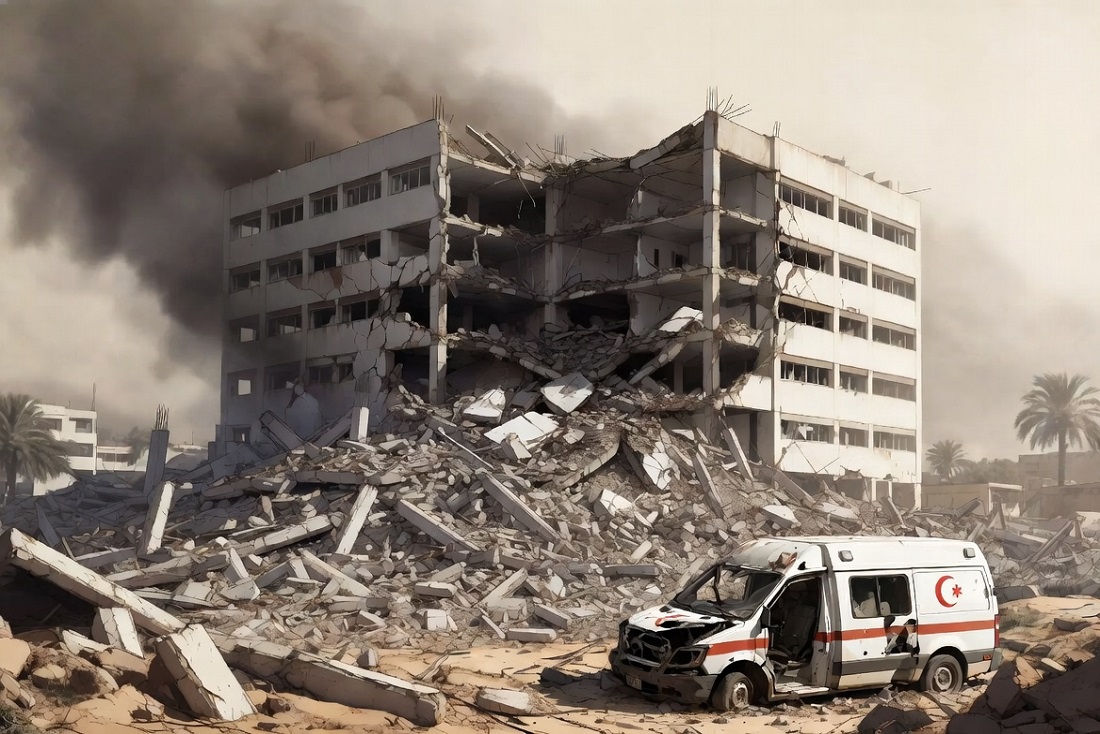
Gaza's health system, described by WHO as "systematically degraded," has been reduced to a shadow of its former capacity. Since October 2023, all 36 hospitals and the majority of primary healthcare centres have sustained damage. According to WHO's 2026 Health Emergency Appeal, over 930 attacks on health infrastructure have been recorded since the war began — attacks that have killed and injured healthcare workers, destroyed ambulances, and rendered entire wards non-functional.
As of early 2026, only half of Gaza's hospitals are partially operational, and not a single hospital can be considered fully functional. Some 48% of primary healthcare centres remain open. All hospitals are entirely dependent on backup generators, but critical electrical components — including spare parts for generators, uninterruptible power supplies, transformers, and ventilators — continue to face severe entry restrictions under Israel's dual-use classification regime, crippling intensive care units, dialysis centres, operating theatres, and laboratories.
The Medical Director of Al-Shifa Medical Complex, Dr. Hassan Al-Shaer, described the health situation plainly: "The health situation is catastrophic." One patient at a medical point in the Al-Shati refugee camp told UN media: "They give us Panadol because there are no medicines available. There is not even anesthesia. If someone is wounded, we ask the doctors to provide treatment, but they are unable to do so."
More than 18,500 injured and chronically ill patients currently require medical treatment unavailable inside Gaza due to the absence of specialised services. They remain trapped, awaiting medical evacuation. Sexual and reproductive health services have been severely disrupted; cancer screening and treatment programmes have been largely suspended since October 2023. Restrictions on equipment classified as "dual-use" — including ultrasound machines, incubators, and mobile maternity units — have devastated antenatal, obstetric, and postnatal care.
The most lethal consequence of this medical collapse has been registered by Doctors Without Borders (MSF), which in May 2026 released an analysis documenting devastating outcomes for pregnant women, newborns, and infants under six months, linking them directly to Israel's blockade of essential goods and attacks on civilian infrastructure. In March 2026 alone, MSF teams were providing an average of 2,475 consultations, 151 hospital admissions, and 44 surgeries per day — a reflection not of successful care, but of overwhelming, unending need.
II. The Hospital Crisis: Bombed, Blockaded, Broken
Since the beginning of 2026, WHO has documented 22 attacks on hospitals and healthcare centres across Gaza. The Al-Shifa Medical Complex — once the largest hospital in the Strip and a symbol of Palestinian healthcare — now stands in ruins. Its generators are destroyed, its ambulances wrecked. It operates as a partial facility serving swelling numbers of patients with virtually no functional infrastructure.
The broader picture is one of deliberate, methodical destruction. A report by Al Jazeera documented how Israel "destroyed Gaza's health system deliberately and methodically," a characterisation echoed by trauma surgeons who volunteered in Gaza. Mohammed Tahir, one such surgeon, described the health sector as "dire." As of February 2026, OCHA recorded 260 of 619 health service points functioning across the Strip — 90% of them only partially. These include 19 of 37 hospitals, 12 field hospitals, 106 primary healthcare centres, and 123 medical points.
The scale of the crisis in the north is particularly acute. For much of the conflict, the entire northern Gaza governorate had no functioning hospitals whatsoever — a situation that amounts to a death sentence for civilians with serious injuries or chronic conditions.
In December 2025, a sweeping decision by Israel to ban 37 international NGOs from operating in Gaza and the West Bank — 15% of total NGOs on the ground — dealt another blow to the already fragile healthcare and relief network. The ban, under Israel's Government Resolution No. 2542, required organisations to submit staff lists including Palestinian personnel, a condition most organisations refused on the grounds that it would expose local workers to targeting, and that it violated principles of humanitarian neutrality. Human Rights Watch stated clearly that "Israel's deliberate restrictions to aid in pursuit of its political or military objectives violate its obligations as an occupying party under international humanitarian law and constitute a war crime."
III. Food Security: Famine Postponed, Not Prevented
In August 2025, the IPC — the world's foremost authority on food insecurity — formally declared famine in Gaza City and surrounding areas. By December 2025, a ceasefire and some improvement in access had technically lifted the famine classification, but the UN and its agencies were unequivocal: this progress was "extremely fragile," and the underlying conditions that caused famine remained entirely intact.
As of late 2025, approximately 1.6 million people — representing 77% of Gaza's population — faced crisis-level hunger or worse. Over 100,000 children and 37,000 pregnant and breastfeeding women were projected to suffer acute malnutrition through April 2026. The IPC estimated that, through June 2026, at least 132,000 children under five would suffer from acute malnutrition — double the estimates from May 2025 — including over 41,000 severe cases at heightened risk of death. FAO, UNICEF, WFP and WHO warned jointly that without large-scale expansion of food, agricultural, and health assistance, "hundreds of thousands of people could rapidly slip back into famine."
Save the Children reported starkly that four out of every five children in Gaza entered 2026 facing crisis levels of hunger.
The roots of this catastrophe are not mysterious. Between early March and mid-May 2025, Israel imposed a total blockade on Gaza, allowing in no food, medicine, or aid whatsoever — a period of more than 11 consecutive weeks. During 2025, between May 27 and August 19 alone, 1,857 Palestinians were killed while seeking food aid, according to the UN — 1,021 of them at or near sites run by the Gaza Humanitarian Foundation (GHF), a US-backed, militarised aid distribution system operating through private contractors. Amnesty International characterised the GHF as "illegitimate and inhumane," noting that its aid sites "often proved deadly for aid seekers."
The humanitarian principle that food must not be weaponised has been fundamentally violated. What the world has witnessed in Gaza is a population deliberately starved as an instrument of military strategy.
IV. The Economic Situation: Total Collapse
The economic devastation of Gaza is without modern parallel. In 2024, Gaza's GDP contracted by 83% compared to 2023 — itself a year of sharp decline. Over 2023–2024, GDP shrank cumulatively by 87% to $362 million. GDP per capita fell to $161, representing just 4.6% of the West Bank's per capita GDP, and among the lowest figures recorded anywhere in the world. UNCTAD described the resulting crisis as "among the most severe economic collapses ever recorded anywhere."
A joint assessment by the World Bank, United Nations, and European Union, released in April 2026, estimated total recovery and reconstruction needs in Gaza at approximately $71.5 billion. Physical infrastructure damages alone amounted to $35.2 billion. Economic and social losses totalled a further $22.7 billion. Reconstructing housing will cost over $16 billion; rebuilding agriculture, food systems, and commercial activity another $19.5 billion; and restoring health, education, and social protection systems approximately $19 billion more.
More than 1.2 million Gazans — roughly 60% of the population — have lost their homes. An estimated 81% of all structures across the Strip have been damaged or destroyed. The housing sector sustained the heaviest damage, but no sector has been spared.
Gaza's once-modest but functioning economy — already severely distorted by 16 years of blockade — has been effectively erased. By 2023, before the current conflict, unemployment stood at 45%, and 80% of households depended on international humanitarian assistance. The war has made even this level of dependency impossible to sustain. As an economist based in Gaza, Saif al-Din Odeh, who previously worked for the Palestinian Monetary Authority, observed: "Economically, the situation in Gaza has not changed since the ceasefire until now."
While real GDP showed a statistical rebound of more than 30% in 2025, economists stress this reflects only a "low base effect" from 2024's historic collapse — not a genuine recovery. Most productive sectors remain paralysed.
V. Israeli Restrictions: The Architecture of Siege
The restrictions imposed by Israel on Gaza since October 2023 — and deepened in 2025 and 2026 — constitute a comprehensive siege architecture that controls every dimension of life: movement of people, entry of goods, functioning of aid organisations, and access to medical care.
The most destructive component has been the blockade of humanitarian aid. At various points, Israel imposed complete closures of all crossings — including Kerem Shalom, Rafah, and Zikim — denying food, fuel, medicine, and construction materials to an entrapped population of more than two million people. Even during periods of partial opening, extensive clearance procedures, including broad restrictions on "dual-use" items, delayed the delivery of medicines, medical equipment, water treatment chemicals, and shelter materials.
Israel's banning of UNRWA in January 2025 — stripping the UN's primary Palestinian relief agency of its right to operate across Israel and the Occupied Palestinian Territories — removed the backbone of the humanitarian response. The ICJ, responding to a UN General Assembly resolution adopted with 137 votes, issued an advisory opinion in October 2025 examining Israel's obligations regarding UN activities in the occupied territories.
In March 2026, the Kerem Shalom crossing was briefly reopened for fuel and limited cargo after a period of complete closure, but the Rafah and Zikim crossings remained shut. Humanitarian staff rotations, medical evacuations, and the return of diaspora Palestinians were not permitted to resume. Sexual and reproductive health equipment — ultrasound machines, incubators, ventilators — remained classified as "dual-use" and thus blocked.
The decision to require aid organisations to submit staff lists — effectively identifying Palestinian aid workers to Israeli authorities — resulted in the forced suspension of 37 NGOs. Israel justified this policy as necessary to "prevent the exploitation of aid by Hamas," but as Human Rights Watch noted, Israeli military officials themselves confirmed in July 2025 that they had never found proof that Hamas has systematically stolen aid.
Critics across the humanitarian and legal communities are united: these restrictions are not incidental to military operations. They are deliberate instruments of collective punishment — a violation of the laws of war.
VI. Failure of the International Community: Law Without Enforcement
The international community's response to the Gaza crisis has been characterised by a catastrophic gap between words and action. Declarations, resolutions, advisory opinions, and emergency statements have proliferated with extraordinary frequency, while the material situation on the ground has continued to deteriorate. This failure is not accidental — it is structural, rooted in the paralysis of the UN Security Council where the United States has repeatedly used its veto power to block binding resolutions demanding a ceasefire, the lifting of the blockade, and accountability for violations of international law.
Humanitarian agencies themselves have come under sharp criticism for their inability to scale up operations in the face of Israeli restrictions. OCHA, UNICEF, WFP, and WHO have issued warning after warning, but their operational capacity has been systematically dismantled by the ban on NGOs, the closure of crossings, and the targeting of their staff. Over 408 humanitarian workers, including more than 280 from UNRWA, have been killed since October 2023 — the highest toll on humanitarian workers in any modern conflict.
The October 2025 ceasefire, widely celebrated as a breakthrough, has proven brittle and incomplete. Since it came into effect, at least 880 people have been killed and more than 2,600 injured. As the WHO representative in Gaza noted in May 2026: "There is perhaps less fire, but the violence continues. We hear bombs nearby. There is gunfire every day."
The OHCHR, in a report released in late May 2026, confirmed that despite the ceasefire, "living conditions have not improved." Children died from hypothermia during the winter of 2025–2026. Tents were destroyed by wind and rain. Sewage continued to flow in many areas. Large amounts of debris rendered entire neighbourhoods inaccessible. The report documented large-scale violations of international law and warned that "impunity, settlement expansion, mass displacement and continued attacks on civilians are entrenching a cycle of violence with generational consequences."
Eighty countries jointly condemned Israel's latest actions in the West Bank at the UN, demanding an immediate reversal. Nearly all members of the Security Council joined that statement — except the United States.
VII. What International Figures Are Saying
The weight of condemnation from global figures has grown with each passing month, even as enforcement mechanisms remain absent.
UN Secretary-General António Guterres, speaking at the General Assembly, described "a scale of death and destruction beyond any other conflict" in his tenure. He condemned the Hamas attacks of October 7, 2023, while unequivocally stating that "nothing can justify the collective punishment of the Palestinian people and the systematic destruction of Gaza." He called for full implementation of ICJ measures, a permanent ceasefire, and unrestricted humanitarian access.
Turkish President Recep Tayyip Erdoğan condemned the violence as "genocide ongoing for over 700 days," noting that more than 65,000 people had been killed, including 20,000 children, and that "a child has been murdered by Israel in Gaza every hour."
South African President Cyril Ramaphosa, invoking his country's struggle against apartheid, stated: "We will not sit silent and watch as apartheid is perpetrated against others." South Africa has filed a genocide case against Israel at the International Court of Justice, a case that has since attracted declarations of intervention from multiple countries.
Jordan's King Abdullah II condemned what he called "unprecedented atrocities that cannot be justified," stating that "the sky-blue flag flying over UN shelters and schools in Gaza has been powerless to protect innocent civilians from Israeli military bombardment."
The UN Security Council briefing of May 21, 2026 heard the UN Special Coordinator stress that "recovery in Gaza must advance the underlying political objectives: the reunification of the Gaza Strip and the West Bank under a single, legitimate, sovereign Palestinian government."
Amnesty International's Secretary-General Agnès Callamard pointed directly to the conduct of leaders, naming Netanyahu, Putin, and Trump as "predators" whose behaviour is "emboldening all of those that are tempted by similar behaviours." She praised Spain as a European outlier "standing above the double standard that is destroying the international system."
VIII. Amnesty International and Human Rights Watch: The Genocide Determination
In December 2024, Amnesty International published a landmark 296-page report — "You Feel Like You Are Subhuman" — concluding that Israel is committing genocide in Gaza. The report found that Israel had carried out acts prohibited under the Genocide Convention "with the specific intent to destroy Palestinians in Gaza," including killings, the causing of serious bodily and mental harm, and the deliberate infliction of conditions of life calculated to bring about the physical destruction of the group.
Secretary-General Agnès Callamard stated: "Month after month, Israel has treated Palestinians in Gaza as a subhuman group unworthy of human rights and dignity, demonstrating its intent to physically destroy them. Our damning findings must serve as a wake-up call to the international community: this is genocide. It must stop now."
Human Rights Watch issued a parallel report three months later, also applying the Genocide Convention's legal framework and reaching similar conclusions. Amnesty's 2026 Annual Report extended this critique globally, noting that Gaza's blockade continues to "defy global pressure despite ICJ scrutiny" — situating it within a broader pattern of "state policy: repression over reform, impunity over justice."
Human Rights Watch's World Report 2026 documented the total 11-week blockade between March and May 2025, the militarised GHF aid system under which over 1,800 Palestinians were killed while seeking food, and Israel's repeated targeting of police forces, security for aid convoys, and civilian administrators — characterising the pattern as one of "systematic destruction."
The ICJ itself, in its October 2025 Advisory Opinion on Israel's obligations under international law regarding UN activities in the occupied territories, provided legal confirmation of what these organisations have been documenting for years: that Israel bears legally binding obligations it has not fulfilled, and that states which allow or enable the blockade of the UN's work may themselves bear international responsibility.
Conclusion: A Crisis of Conscience, Not Capacity
The situation in Gaza in 2026 is not primarily a crisis of logistical capacity or geopolitical complexity. It is a crisis of political will and moral accountability. The resources to feed two million people, to supply hospitals with medicine, to allow doctors to operate, to permit humanitarian workers to do their jobs — all of these exist. What has been systematically denied is the permission to deploy them.
The international legal architecture — the Geneva Conventions, the Genocide Convention, the ICJ, the ICC, UN Security Council resolutions — has produced a record of condemnation that is historically unprecedented. Yet Gaza's population has continued to be killed, starved, displaced, and denied medical care while the machinery of accountability grinds at a pace measured in years, not emergencies.
What is required is not more documentation. It is enforcement. It is the political courage of governments to apply the sanctions, arms embargoes, and diplomatic consequences that international law demands — and that the people of Gaza, now approaching three years of devastation, are owed.
Sources: WHO, OCHA, UNICEF, UNRWA, WFP, FAO, MSF, Human Rights Watch, Amnesty International, UNCTAD, World Bank, IPC, ICJ, Save the Children, Al Jazeera, UN News, OHCHR — data current as of June 2026.

The best of Tired Earth delivered to your inbox
Sign up for more inspiring photos, stories, and special offers from Tired Earth
By signing up for this email, you are agreeing to news, offers, and information from Tired Earth. Click here to visit our Privacy Policy.





Comment
Reply