



22 Mar 2026

Tired Earth
By The Editorial Board
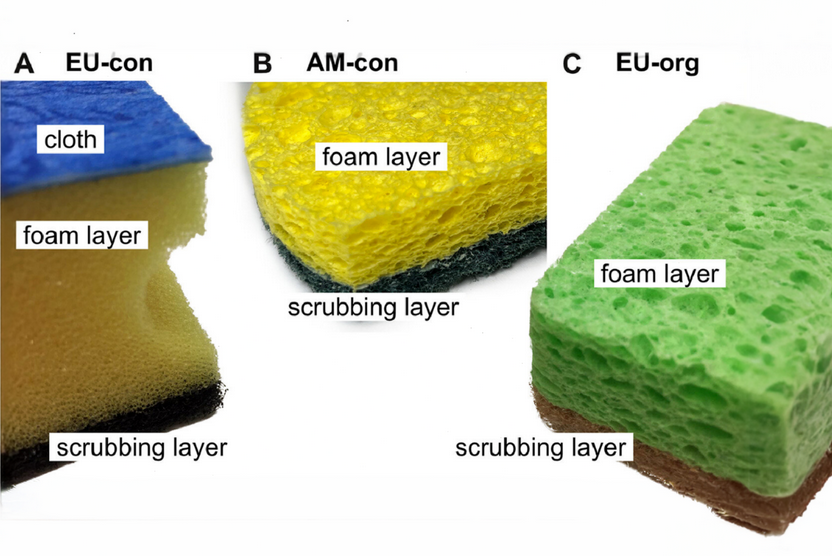
Material layers for each sponge type: A) EU-con, B) AM-con, and C) EU-org. Microscopic images of each layer can be found in SM-1A. Credit: Environmental Advances (2026). DOI: 10.1016/j.envadv.2026.100693
edited by Sadie Harley, reviewed by Robert Egan
Kitchen sponges are considered a potential, yet largely understudied, source of microplastics in households. A study in Environmental Advances investigated how many microplastic particles are released from kitchen sponges during use and what environmental impacts result. The paper is titled "From sink to sea: Microplastic release from kitchen sponges and potential environmental effects."
The aim was to quantify the actual release under realistic usage conditions and to assess the environmental impacts using a life cycle assessment (LCA).
The study combined citizen science—where members of the public actively conduct experiments—with laboratory tests. Volunteer households in Germany and North America used one of three different sponge types in their daily routines and documented their usage.
The sponges were weighed before and after use to determine material loss and microplastic release. In addition, laboratory experiments were carried out using an automated test device ("SpongeBot") that simulates the mechanical stress applied to sponges during dishwashing.
All investigated sponges lose material during use and thereby release microplastics. The annual release ranges from approximately 0.68 to 4.21 grams of microplastics per person per year, depending on the sponge type. Sponges with a lower plastic content release significantly less microplastic.
Overall, however, the analysis showed that it is not the microplastic release itself, but primarily the water consumption during manual dishwashing that contributes most to the environmental impact.
Citizen science played a central role, as volunteer participants used the sponges under real-life conditions. This allowed for the capture of realistic usage patterns and typical dishwashing habits. These data enabled a much more realistic estimation of microplastic release compared to purely laboratory-based studies.
Although the amount per person appears low, when extrapolated to Germany, significant quantities can be reached, for example, up to 355 metric tons of microplastics per year if a specific sponge type is used in every household. While a large proportion of these particles are retained in wastewater treatment plants, several tons still enter aquatic environments or soils annually.
At the same time, the environmental assessment shows that around 85% to 97% of the total environmental impact of dishwashing is attributable to water consumption, while microplastic emissions contribute a much smaller share to overall ecosystem damage.
The study identifies several ways to reduce environmental impact:
Source : phys.org

The best of Tired Earth delivered to your inbox
Sign up for more inspiring photos, stories, and special offers from Tired Earth
By signing up for this email, you are agreeing to news, offers, and information from Tired Earth. Click here to visit our Privacy Policy.





Comment