


10 Feb 2026

Tired Earth
By The Editorial Board
by Matt Davenport, University of Michigan
edited by Lisa Lock, reviewed by Robert Egan, phys.org
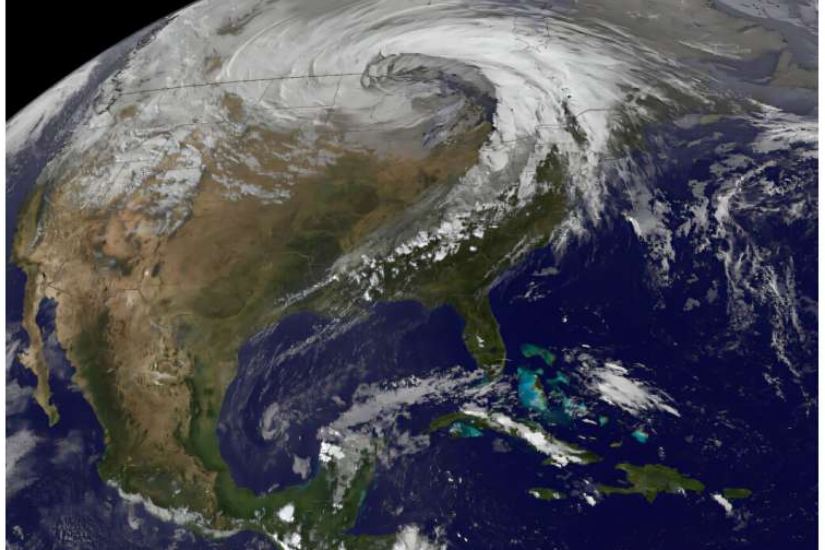
Research from the University of Michigan has shown how global climate patterns are influencing extratropical cyclones in the Great Lakes region, like this strong storm from 2010 that’s centered on Northern Minnesota and Southern Canada. Credit: NASA Earth Observatory
About a year ago, researchers at the University of Michigan found that the extratropical cyclones that are the biggest drivers of winter weather in the Great Lakes region are warming and trending northward. That means, outside of the northern reaches of the region, residents can expect that their winters will be warmer and wetter on average.
Now, some of those same researchers have dug deeper to find more subtle connections between climate patterns playing out around the world and the Great Lakes' extratropical cyclones. Now that these long-distance linkages, or teleconnections, have been revealed, understanding them better could help Great Lakes meteorologists better predict weather during any given winter, said study leader Abby Hutson. The research is published in the Journal of Geophysical Research: Atmospheres.
"This has great implications for sub-seasonal to seasonal forecasting," said Hutson, an assistant research scientist with the Cooperative Institute for Great Lakes Research, or CIGLR. "These cold season cyclones, these big winter storms that impact the Great Lakes region, the weather in them and their activity are influenced by large, global interactions, but maybe not in the way we always think."
Although they might not know it, most people already have some familiarity with what scientists call "global teleconnections." The El Niño-La Niña cycle, known technically as the El Niño-Southern Oscillation or ENSO, is perhaps the best known example of how Earth processes happening in one location can have far-reaching effects.
During El Niño, winds over the Pacific Ocean change in a way that sends warmer water moving toward the west coast of the Americas. During La Niña, the changing winds push warm water toward Asia. Although these changes are playing out in the Pacific, their impacts are felt across continents, including in the Great Lakes region.
"In a La Niña, we expect that the Great Lakes region will be colder and wetter, whereas during winter during an El Niño, the pattern is warmer and dryer," Hutson said.
In its study, the team examined how ENSO and five other teleconnections have affected extratropical cyclones traveling over the Great Lakes between 1959 and 2023. The team found that, while the teleconnections had no significant impact on the number of cyclones in the Great Lakes region, the teleconnections could influence other factors, including the temperature and water content of a cyclone's air, said Sydnie Hansen, who helped lead the study as a 2024 Summer CIGLR Fellow.
This was particularly true of three of the teleconnections studied. Interestingly, none was the well-known ENSO. The strongest impacts were in connection with the North Pacific Gyre Oscillation, the Pacific North American Pattern and the Arctic Oscillation, abbreviated as NPGO, PNA and AO, respectively. As an example of how these impacts could shape forecasts, Hansen detailed what happens during one swing, or phase, of the PNA cycle.
"With PNA during its negative phase, we see warmer temperatures in the storms, we see more moisture being brought into the system and we do see a localized increase in precipitation," Hansen said. "But what's really interesting is that a majority of the teleconnections we studied, they do have a dynamic, changing relationship with extratropical cyclones as time goes on. So that means we may see a more pronounced difference in storm behavior between, say, ENSO positive and negative phases in the future."
In addition to studying these changes over time, there are more teleconnections and more features of extratropical cyclones that researchers can study to further enhance our understanding of these connections, Hutson said.
Source : phys.org

The best of Tired Earth delivered to your inbox
Sign up for more inspiring photos, stories, and special offers from Tired Earth
By signing up for this email, you are agreeing to news, offers, and information from Tired Earth. Click here to visit our Privacy Policy.




Comment