



11 May 2026

Tired Earth
By The Editorial Board
A key Atlantic Ocean current system that helps regulate the planet's climate could weaken more than expected by 2100, with potentially devastating consequences worldwide, a new study has found.
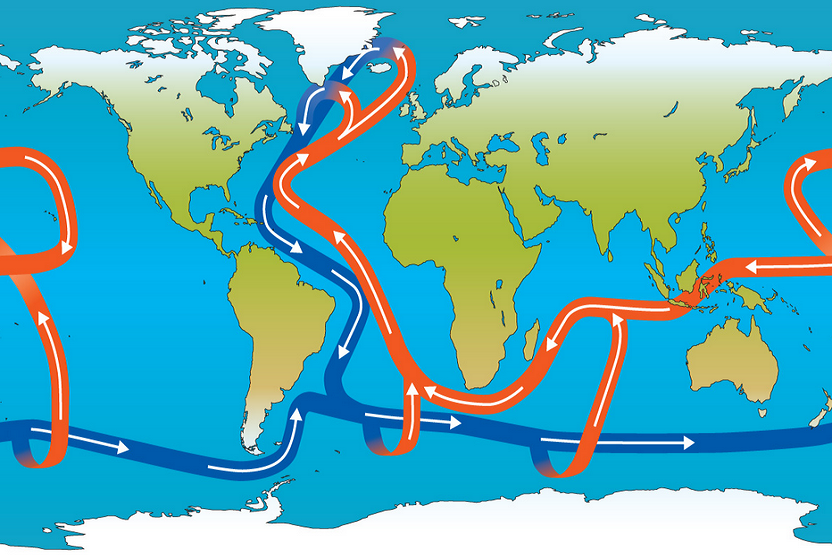
Known as Atlantic Meridional Overturning Circulation (AMOC), this conveyor belt of currents plays a crucial role in redistributing heat by transporting warmer waters from the tropics northward.
An AMOC collapse could lead to harsher winters in northern Europe, droughts in South Asia and the Sahel region in Africa, and higher sea levels in North America, among other consequences.
Previous climate model projections have estimated an average slowdown of around 32% by the end of the century due to climate change.
The latest study, published in the journal Science Advances, estimates that the system could slow by 51% by 2100 under a mid-range scenario for greenhouse gas emissions, with a margin of error of plus or minus eight percentage points.
"We obtained an estimate of a future AMOC slowdown that is more severe than we expected," climate scientist Valentin Portmann, the paper's lead author, told AFP.
"We are closer to a critical state that is worrying," Portmann said.
Predicting what will happen to AMOC in the future is a topic of debate in the scientific community.
"There is a kind of consensus on the fact that this circulation will slow down. But there is still quite a bit of debate about the intensity of this slowdown," said Florian Sevellec, research director at the French National Centre for Scientific Research (CNRS) in Brest, France.

The Atlantic Meridional Overturning Circulation (AMOC) is sort of a conveyor belt of currents that plays a crucial role in climate regulation.
In its 2021 report, the UN's Intergovernmental Panel on Climate Change said AMOC will "very likely decline" over this century.
But the panel of international experts also expressed "medium confidence" that a collapse of AMOC would not take place before 2100.
The latest study, conducted by researchers from the CNRS and the University of Bordeaux in southwest France, seeks to "refine this estimate of the future slowdown" and "reduce uncertainty", Sevellec said.
While nearly all climate models predict an AMOC slowdown by 2100, the projections range widely: from as little as 3% to as much as 72%, depending on varying emissions scenarios.
Portmann said the new study seeks to narrow that uncertainty using "observational constraints"—a statistical approach that combines real-world observations with results from climate models.
Stefan Rahmstorf, an oceanographer at the Potsdam Institute for Climate Impact Research (PIK), said the paper showed that pessimistic models "are unfortunately the realistic ones, in that they agree better with observational data."
Discover the latest in science, tech, and space with over 100,000 subscribers who rely on Phys.org for daily insights. Sign up for our free newsletter and get updates on breakthroughs, innovations, and research that matter—daily or weekly.
Rahmstorf, who who was not involved in the study, said that this means AMOC would be so weak by 2100 that it would "very likely" be "on the way to full shutdown."
Fabien Roquet, a physical oceanography professor at the University of Gothenburg in Sweden, said the study was interesting but he cautioned that another team using a similar method reached opposite conclusions last year.
"What is certain, however, is that the climate is warming rapidly," Roquet said.
"Whether the AMOC weakens or not, large-scale changes are already underway... and should intensify in the coming decades."
"The debate is not over," said Sevellec, who was also not part of the research team but whose thesis on AMOC was used for the study. "One paper does not settle a scientific debate."
Source : phys.org

The best of Tired Earth delivered to your inbox
Sign up for more inspiring photos, stories, and special offers from Tired Earth
By signing up for this email, you are agreeing to news, offers, and information from Tired Earth. Click here to visit our Privacy Policy.



Comment