



14 Mar 2026

Tired Earth
By The Editorial Board
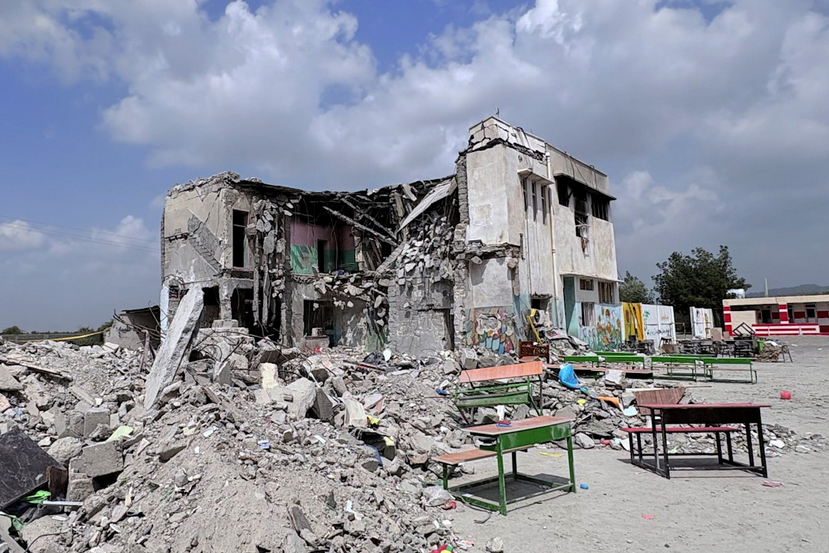
The rubble of the Shajareh Tayyebeh girls’ primary school in Minab, Iran, after a missile strike on February 28, 2026. The attack killed scores of students, and has been denounced by rights groups as a blatant violation of the laws of war
On February 28, 2026, a powerful guided missile struck the Shajareh Tayyebeh girls’ school in Minab, Hormozgan province (southern Iran), killing well over a hundred civilians, mostly young schoolgirls. Human Rights Watch immediately condemned the strike as “a violation of the laws of war that cannot be boiled down to a blameless mistake”. Under international humanitarian law, such an indiscriminate attack on a civilian school is prohibited. As HRW emphasizes, even if the school had been near a military base, attacking it without taking “all feasible precautions to avoid civilian harm” breaches the rules of war. In plain terms, deliberately or recklessly hitting a school full of children would be a war crime.
International legal norms are clear:
- Target verification: An attacker “must do everything feasible to verify that targets are military objectives” and cancel strikes if not. No evidence suggests any legitimate military target stood on the school grounds. Satellite imagery shows the school was separated by a wall from the IRGC naval compound next door, underscoring its civilian character.
- Civilian protection: Attacks must avoid “disproportionate” civilian casualties compared to military gain. A precision missile strike on a school – with students and teachers present during a school day – cannot be reconciled with this rule. An attack not aimed at a specific military objective is by definition indiscriminate and outlawed.
- War crime criteria: “Serious violations of the laws of war … committed deliberately or recklessly” constitute war crimes. Here, open-source analysts report that multiple buildings around the school were hit in near-simultaneous strikes– a pattern of guided-weapon hits, not a stray blast. Under the laws of armed conflict, the Minab strike meets the threshold of a grave war crime.
Human Rights Watch notes that the U.S. military had an obligation to prevent such civilian harm. In fact, HRW cites press reports that a Pentagon probe found this tragedy resulted from a “targeting mistake” using outdated coordinates. HRW warns that failing to verify up-to-date data – or ignoring the known presence of a school – is inexcusable. As HRW’s Sarah Yager put it, even if the strike was not intended to hit a school, “the US military has an obligation to take all feasible precautions to avoid civilian harm, which it clearly did not do in this case”.
Evidence of U.S. Involvement
Multiple investigations point to an American origin for the attack. Video captured on the morning of Feb 28 shows a cruise missile hitting the IRGC base immediately adjacent to the school. Experts tell CNN the missile’s cruciform tail and folding wings match a U.S. BGM-109 Tomahawk – a weapon Iran and Israel do not use. (The U.S. Navy has been firing Tomahawks from ships and subs in this war, while Israel does not possess them) CNN analysis also geolocated footage showing the school and base hit within minutes of each other, consistent with simultaneous precision strikes. Likewise, independent open-source investigators (e.g. on Bellingcat) have found that recent satellite imagery and strike videos show multiple blasts striking both the separate school and the adjacent IRGC compound in quick succession. A Google Earth time series even confirms that as of 2016 a fence had long separated the civilian school from the military site, making it clear the school was no passive part of the base.
In short, the evidence is mounting that the strike was not an errant munition or an Iranian defensive missile at all but an American strike. U.S. media outlets report that “only the US” uses the observed missile. And notably, senior U.S. officials have now acknowledged the investigation: a Reuters scoop cites Pentagon sources saying investigators think it is “likely” U.S. forces were responsible. President Trump himself initially blamed Iran, but Defense Secretary Pete Hegseth has since confirmed a formal probe. (The White House meanwhile claims the Iranian regime itself targets civilians, but human rights law holds belligerents to objective standards of conduct.)
Laws of War: Violations and War Crimes
Humanitarian law explicitly forbids the scenario we see at Minab. The Geneva Conventions and Additional Protocols – binding on all combatants – demand that attacks distinguish military targets from civilians, avoid disproportionate deaths, and abort strikes if a target is not legitimate. HRW summarizes these requirements:
⦁ Attacking forces “must do everything feasible to verify that targets are military objectives” An object (or building) presumed to be military loses that status the moment intelligence shows civilians are present. No evidence suggests an IRGC unit was inside the school at the time.
⦁ The law prohibits indiscriminate attacks – those “not directed at a specific military objective” Striking a school filled with children is the very definition of indiscriminate.
⦁ Even if a true military target were nearby, any attack must weigh civilian harm against concrete military gain. Here the harm was incalculable – scores of children’s lives – while the school itself served no immediate military function. Thus the attack was “disproportionate” to any conceivable objective
Moreover, the Rome Statute of the International Criminal Court (and customary law) explicitly labels intentional or reckless attacks on civilians as war crimes. As the UN human rights office noted, “deliberately attacking a school or hospital or any other civilian structure would likely be a war crime under international humanitarian law.” If these findings are borne out – that a U.S. strike killed more than 160 students – this would rank among the worst U.S.-caused civilian massacres in decades.
Human Rights Watch and other rights advocates therefore insist on accountability. HRW states bluntly: “Those responsible for the Minab school attack should be held accountable, including through prosecutions where appropriate.” The UN rights office similarly stressed that “the onus is on the forces that carried out the attack to investigate it.” Under the laws of war, any government found to have committed such a violation owes full reparation – compensation, rehabilitation, etc. – to victims and their families. In short, Washington must not only admit what happened but also take steps to punish and deter such errors. Many experts note that U.S. targeting procedures (which include legal reviews and collateral-death assessments) appear to have failed here, and Congress and the public deserve a full accounting of that failure.
Grave Conclusions, Stark Accountability
From the human rights perspective, the Minab strike is nothing short of a man-made atrocity. Independent monitors, journalists and even former U.S. officials (e.g. Leon Panetta on CNN) have pointed out that striking an elementary school undermines any claim of moral or legal justification. The event has provoked condemnation worldwide. The European Parliament and UN experts have called it out as a war crime demanding investigation. Human rights defenders insist this tragedy must prompt a re-examination of the war’s conduct: no military goal could possibly justify slaughtering dozens of children.
As HRW observes, the Minab attack was “an unlawful attack” in violation of fundamental legal norms. Critics of the US campaign in Iran see it as emblematic of a drift away from lawful warfare. They demand that the United States – having conducted this “illegal strike” – publicly release its findings and hold those responsible to account. Without transparency and justice, the horror at Minab will only deepen distrust of U.S. claims to be fighting a “just war.” In a conflict already marked by severe civilian suffering, the Minab school massacre stands out as a moral abyss that Washington must now face with honesty and with actions to repair the damage.
Sources: Independent investigations and media reports (HRW, Reuters, CNN, ABC News) detail the Minab strike and its aftermath, including expert analysis of weapon remnants and legal commentary. International law and the cited human rights statements underline the strike’s unlawful nature. All facts are drawn from these authoritative accounts.

The best of Tired Earth delivered to your inbox
Sign up for more inspiring photos, stories, and special offers from Tired Earth
By signing up for this email, you are agreeing to news, offers, and information from Tired Earth. Click here to visit our Privacy Policy.





Comment
Reply