



19 Apr 2026

Tired Earth
By The Editorial Board
In an unprecedented development following military tensions in the Middle East, Iran's Supreme National Security Council has announced that all ships crossing the Strait of Hormuz will now be required to pay environmental fees.
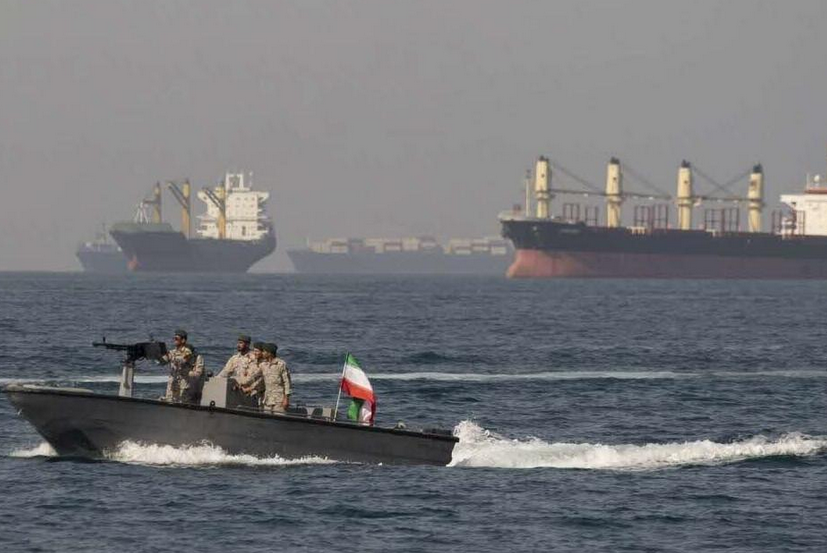
In an unprecedented development following military tensions in the Middle East, Iran's Supreme National Security Council has announced that all ships crossing the Strait of Hormuz will now be required to pay environmental fees.1
This decision comes amidst a war marked by what many observers have denounced as a blatant disregard for the environmental consequences of military operations carried out by the United States and Israel. Among the most striking episodes are the airstrikes targeting Iranian oil infrastructure, which triggered massive fires, toxic emissions, and acid rain, contaminating soil and groundwater.
A Breakthrough: The Environment Enters the Logic of War
In this context, the Iranian initiative marks a significant shift. For the first time, a state directly involved in a conflict is explicitly attempting to integrate environmental costs into the dynamics of power and confrontation.
This measure suggests a potential transformation in the implicit rules of contemporary warfare: the environment is no longer just a collateral victim of war, but becomes a recognized factor in strategic balances.
By imposing an ecological fee, Iran introduces the idea that global energy flows—especially those linked to oil—can no longer be dissociated from their environmental impacts.
An Ethical Dimension: Towards a New Environmental Legitimacy
From an environmental ethics perspective, this decision can be interpreted as an attempt to redefine responsibilities.
It rests on several implicit principles:
If implemented transparently, this policy could grant Iran a new form of moral legitimacy, placing the environmental issue at the heart of a space traditionally dominated by strictly military and economic logics.
The Persian Gulf: An Already Fragile Ecosystem
The significance of this decision becomes even clearer when considering the environmental history of the Persian Gulf, one of the most vulnerable marine areas in the world.
For decades, the intensive passage of oil tankers through the Strait of Hormuz has exposed this ecosystem to constant risks, including chronic pollution related to hydrocarbon transport, accidental spills, and disruptions to marine habitats.
The most emblematic precedent remains the Gulf War, during which millions of barrels of oil were spilled into the sea, causing one of the worst ecological disasters in maritime history.
In this context, any initiative aimed at regulating and holding maritime traffic accountable in this area is of particular importance.
What Possible Future Effects?
If this measure were to be effectively implemented, its implications could be manifold.
Environmentally, it introduces an ecological accountability logic in the Strait of Hormuz. By imposing a cost on ships, it directly incentivizes companies to reduce their emissions, improve their practices, and limit the risks of marine pollution.
It could also help fund protection efforts in the Persian Gulf, a particularly fragile ecosystem, supporting the restoration of natural environments and combating pollution.
Finally, this initiative exerts indirect pressure for stricter environmental standards on the international scale, by concretely integrating ecological costs into a strategic trade route for the first time.
Economically, one could also mention the gradual integration of ecological costs into global supply chains and the transformation of energy transport models.
However, What is Crucial Are the Political Implications of This Initiative, Particularly the Emergence of a New Form of Environmental Diplomacy in the Context of Conflict and the Repositioning of Ecological Issues at the Heart of International Power Relations.
Conclusion: A Symbolic Gesture with Global Implications
Even if this measure were to remain partially applied or symbolic, it could mark the beginning of a profound change.
It raises a key question: can the global economy continue to function without integrating the true cost of environmental destruction?
By using a strategic point like the Strait of Hormuz to introduce this reflection, Iran is presenting a form of global environmental justice, in a context where it is both a victim of economic pressures and ecological degradation linked to conflicts and sanctions.
Thus, beyond its immediate implications, this decision outlines a possible evolution in international relations: a world where the environment is no longer a blind spot in war and trade, but a central element in their regulation.

The best of Tired Earth delivered to your inbox
Sign up for more inspiring photos, stories, and special offers from Tired Earth
By signing up for this email, you are agreeing to news, offers, and information from Tired Earth. Click here to visit our Privacy Policy.



Comment
Reply