



02 May 2026

Tired Earth
By The Editorial Board
On the shores of the Black Sea, Ukraine's campaign to cripple Russia's energy revenues is creating an environmental catastrophe of recklessness—one that poisons the air, the soil, and the sea, with consequences that will long outlast any ceasefire.
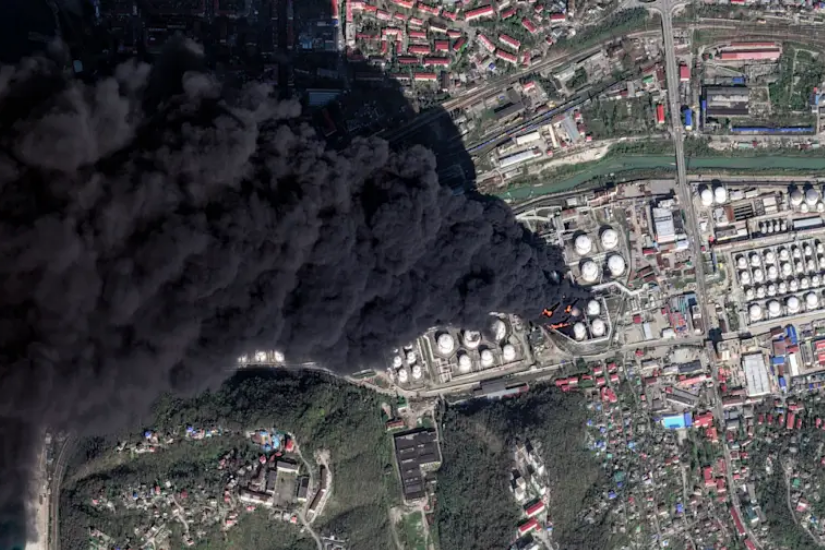
TUAPSE, Russia. For the fourth time in just over two weeks, the sky above this Russian port city has turned an unnatural shade of grey-black. The cause is not a storm, but a war unfolding far from the front lines.
Ukrainian drones have repeatedly struck the oil refinery and seaport of Tuapse, a vital hub for Russian energy exports on the northeastern coast of the Black Sea. The attacks—part of a deliberate Ukrainian strategy to cripple Moscow's economic engine—have succeeded in halting production. But success has come at a staggering environmental cost, turning a popular resort coastline into a toxic sacrifice zone.
Local residents now speak of "black rain"—water droplets blackened by soot, ash, and vaporized oil falling from the sky, coating cars, homes, and the fur of stray animals in a greasy, carcinogenic film. The beaches, once a destination for summer tourists, are now stained with heavy oil slicks. And the sea is giving up its dead: dolphins, seabirds, and fish washing ashore, victims of an unfolding ecological disaster. [1]
Olga, a resident who spoke with Al Jazeera, captured the despair felt by many:
"It will impact people's health, our children's health, the environment, and the future of the town," one local woman told a volunteer cleanup crew. "All of this could have been avoided. But someone's ambitions and decisions once again proved more important than our safety." [2]
A Calculated Gamble
Ukraine's intensified campaign against Russian energy infrastructure is not a random act of desperation, but a calculated strategic gamble. With the war entering its fourth year, President Volodymyr Zelenskyy has made clear that disrupting the Kremlin's oil revenues is a top priority. The port of Tuapse, which handles millions of tons of oil products annually, has become a repeated target precisely because of its economic importance.
"We are hitting facilities that work for the Russian military-industrial complex and the budget," a spokesperson for Ukraine's SBU security service stated following the most recent strike.
But this campaign is unfolding within a unique and perverse global context. The ongoing military confrontation between the United States, Israel, and Iran has effectively closed the Strait of Hormuz, through which roughly 20 percent of the world's oil once flowed. The resulting supply shock has driven global crude prices sharply higher—a development that has inadvertently created a financial buffer for Moscow.
As one economic adviser noted, the crisis in the Middle East "saved the Russian oil sector and the federal budget from a crisis that was clearly developing." In other words, Ukraine is striking Russia's oil industry at a moment when the world is being forced to pay more for every barrel, partially offsetting the very losses Kyiv is trying to inflict.
Ukraine's leadership appears to understand this dynamic but has chosen to press forward regardless. The goal is to cut into Russian profits despite the global price support—even if the method leaves behind a trail of toxic devastation.
The Toxic Toll
The environmental consequences of this strategy are no longer theoretical. They are visible, measurable, and worsening by the day.
Right now, in Russia's Tuapse, it's literally raining oil. After drone strikes, black soot covers the city, animals are dying, and a 10,000 sq m slick is spreading in the Black Sea. And the president is radio silent.
— Mikhail Khodorkovsky (@khodorkovsky_en) April 27, 2026
[2/16] pic.twitter.com/CqA2cfS3ly
Air and "Black Rain"
The massive fires at the Tuapse refinery have released a deadly cocktail of pollutants into the atmosphere. Monitoring stations recorded levels of benzene, xylene, and soot up to three times above established safety thresholds. Benzene, a known Group 1 carcinogen, has no safe level of exposure. Residents have been warned to remain indoors, keep windows sealed, and drink only bottled water. The "black rain" phenomenon—well-documented following the bombing of Hiroshima and the Kuwaiti oil fires of 1991—has deposited a layer of toxic grime across the region.
Devastated Coastline
Along approximately 77 kilometers of shoreline, heavy fuel oil has washed ashore, transforming sandy beaches into blackened wastelands. The oil does not simply coat the surface; volunteers report it has seeped deep into pebbles, rocks, and sand, making conventional cleanup methods largely ineffective.
"The oil is everywhere—on the surface, under the stones, in the water," one volunteer told a local news outlet. "We are shoveling toxic earth with our own hands, and there is no end to it."
Marine Life Massacre
The impact on the Black Sea's ecosystem is emerging as a slow-motion catastrophe. Oil slicks block sunlight and reduce oxygen exchange, suffocating marine life at the base of the food chain. More visibly, the carcasses of common dolphins—a protected species in the Black Sea—have begun washing ashore. Autopsies point to acute toxicity and respiratory failure.
Seabirds have been hit hardest. Oil destroys the waterproofing of their feathers, leading to hypothermia, exhaustion, and drowning.
Volunteers at local rehabilitation centers report receiving dozens of oil-covered birds, most of whom cannot be saved.
"It's a massacre," one ecologist said. "We are watching an ecosystem die in real time."
An activist from a local environmental group echoed this grim assessment: "In the next few years, every storm will be bringing more oil pollution onto the coast. The damage is done. It will not heal quickly."
The Overwhelmed Cleanup [3]
Russian authorities have acknowledged the scale of the disaster. To date, they report having removed over 13,300 cubic meters of contaminated soil and fuel oil from the coastline. State television has broadcast images of workers in hazmat suits and reporters standing on blackened beaches, using spades to demonstrate how deep the oozing filth has penetrated.
A Pyrrhic Victory?
From a purely military standpoint, Ukraine's campaign has achieved measurable success. The Tuapse refinery has been rendered inoperative. Russian oil exports have been disrupted. And the Kremlin has been forced to divert resources to defend far-flung energy infrastructure.
But the environmental arithmetic tells a different story.
The rising global oil price—driven by the crisis in the Middle East—means that Russia's budget has not yet felt the full force of Ukraine's strikes. The immediate financial pain has been absorbed not by Moscow, but by the local environment, the civilian population of Tuapse, and the wildlife of the Black Sea.
And the long-term damage is only beginning to be understood. Soil and groundwater contamination will persist for years. Marine ecosystems may take decades to recover, if they recover at all. Human health consequences—from respiratory disease to cancer—may not fully manifest for a generation.
Ukraine is winning tactical battles against Russia's oil industry. But the campaign is leaving behind a poisoned landscape, a dying sea, and a population left to breathe black rain and shovel toxic earth.
All of this, as one resident put it, could have been avoided.
[1] https://mezha.net/eng/bukvy/24104729_ukrainian_drones_struck/
[2] https://www.aljazeera.com/news/2026/4/30/its-all-very-toxic?traffic_source=rss
[3] https://www.eng.kavkaz-uzel.eu/articles/74897
photo: This satellite image provided by Vantor shows smoke rising from oil infrastructure in Tuapse in the southern Krasnodar region of Russia on April 16, 2026, after the town's oil refinery and shipping terminal were attacked by Ukrainian drones multiple times in preceding weeks. (Satellite image 2026 Vantor via AP)

The best of Tired Earth delivered to your inbox
Sign up for more inspiring photos, stories, and special offers from Tired Earth
By signing up for this email, you are agreeing to news, offers, and information from Tired Earth. Click here to visit our Privacy Policy.


Comment
Reply