


02 Nov 2026

Tired Earth
By The Editorial Board
An international study led by the University of Tehran reveals that human interventions are the primary driver of the drying of the Tigris-Euphrates basin—far ahead of climate change. The finding calls for a rethink of transboundary cooperation, as droughts and dust storms hit Iran and Iraq hard.
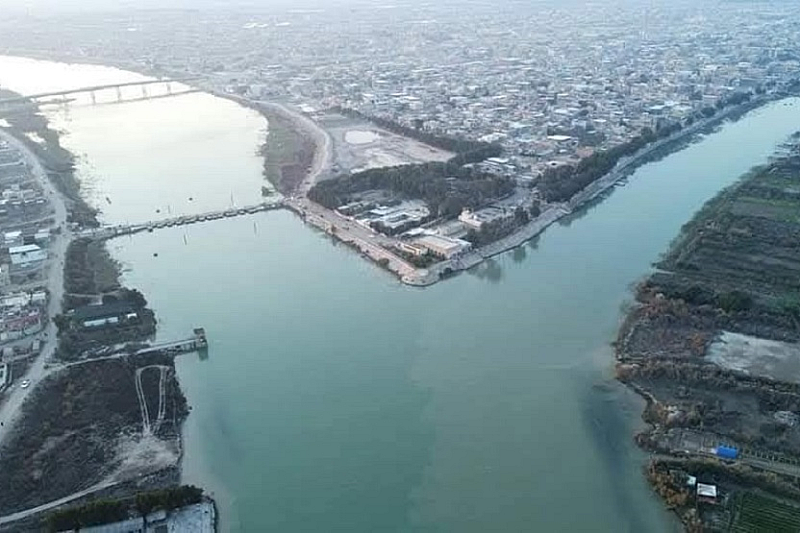
The Tigris-Euphrates basin, shared by Turkey, Syria, Iraq, and Iran, is enduring an unprecedented water crisis. But who is really responsible? A research team led by Dr. Ali Darvishi Bolourani of the University of Tehran, in collaboration with Kuwaiti, Italian, and Australian academics, provides a quantified answer in a study published in the journal Environmental Science and Policy.
Their conclusion is unequivocal: human interventions account for 39.3% of the degradation of water resources, compared with 13.6% for climate change. In other words, the human hand weighs nearly three times more heavily than the climate in this unfolding catastrophe.
Forty Years of Data to Separate Fact from Fiction
To reach this result, the researchers deployed an innovative methodology. Over four years, they integrated multi-source satellite data, hydro-climatic analyses, and water balance equations to examine the basin's evolution over four decades, from 1984 to 2022.
Their work confirms a powerful trend: over this period, average precipitation fell by 9.6%, while evaporation rose by 6.3%. But the most striking factor remains human control over river flows.
The volume of water stored in upstream dam reservoirs more than doubled in thirty years, creating new evaporation surfaces of 9,500 square kilometers. Turkey's Southeastern Anatolia Project (GAP), with its 22 dams and 19 hydroelectric plants, has profoundly altered the course of the rivers. As a result, the flow of the Tigris and Euphrates into Iraq fell by 25% between 1990 and 2016.
An Unequally Shared Burden
For Dr. Darvishi Bolourani, the stakes go far beyond Iraq's borders. "This basin is of particular importance to Iran, because water scarcity or its drying up triggers dust storms that directly affect the lives of Iranians, especially in the southwest of the country," he explains.
The researcher points to a fundamental contradiction: "The massive construction of dams in Turkey, Iraq's manipulation of resources, and agricultural expansion without regard for environmental flows have certainly favored agricultural development upstream. But for downstream populations, this has had catastrophic consequences: drying wetlands and intensifying dust storms across West Asia."
Iraq, on the front line, bears the devastating effects. The country experienced its driest year on record in 2025, with water reserves falling below 4 billion cubic meters, compared with around 60 billion in 2020. Projections point to a water deficit of approximately 10 billion cubic meters by 2035, resulting in the loss of some 25,000 hectares of agricultural land each year.
Toward Smart Management of Human Interventions
The study's authors do not stop at diagnosis. They call for a paradigm shift. According to them, managing the water crisis in the Tigris-Euphrates basin "requires more than simple adaptation to climate change or a fight against dust storm hotspots." It demands "smart management of human interventions, strengthened transboundary cooperation, and the formulation of sustainable development policies across the entire basin."
A recommendation that resonates as a warning for Europe, where tensions over transboundary water are also intensifying. For if the climate is an aggravating factor, the primary responsibility for the drying of these historic rivers rests on political and economic choices. And that may be good news: unlike the climate, human decisions can change.
Source : sciencedirect.com

Plastic Pollution in Cameroon and Africa Plastic Pollution in Cameroon and Africa

The best of Tired Earth delivered to your inbox
Sign up for more inspiring photos, stories, and special offers from Tired Earth
By signing up for this email, you are agreeing to news, offers, and information from Tired Earth. Click here to visit our Privacy Policy.



Comment