Lielaphis slashi, or Slash's groundsnake, is genetically distinct from its relatives and inhabits threatened forest ecosystems.
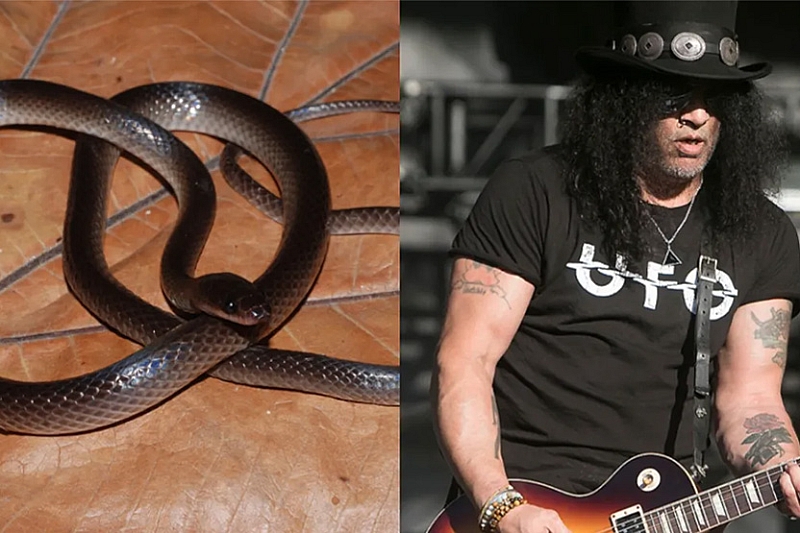
A 28-inch reddish-brown snake discovered in the dense forests of New Guinea has been officially named after rock legend Slash, the iconic guitarist of Guns N' Roses. The newly identified species, Lielaphis slashi, pays tribute to Saul Hudson—better known as Slash—whose lifelong passion for reptiles and support for natural history institutions inspired the naming.
"I have been a herpephile for as long as I can remember, and to have a snake named after me is an extraordinary honor. I never imagined this moment would come," said Slash in response to the announcement.
A Personal Connection Between Science and Rock Music
The choice of name holds special significance for Dr. Sara Ruane, Associate Curator of Herpetology at the Field Museum and senior author of the study published in Zootaxa. "Guns N' Roses has been one of my favorite bands since first grade, and by fifth grade, I had already told my teacher I wanted to be a herpetologist," Ruane explained. "When I was twelve, I received my copy of Reptiles Magazine with Slash on the cover holding a reticulated python, and I thought, 'This guy is so cool.'"
Years later, as a scientist with the privilege of naming newly discovered species, Ruane revisited that childhood memory. "I reread his interview, and he spoke about his love for museums, zoos, and natural history—how he'd go outside as a kid looking for snakes. It was all very relatable, and it made me think he would be a great person to name a species after."
A Serendipitous Discovery in the Forests of New Guinea
The snake was first encountered in 2006 during nighttime fieldwork by Dr. Chris Austin, professor and curator of herpetology at the Louisiana State University Museum of Natural Science. "New Guinea groundsnakes are nocturnal, so the best time to find them is after sunset near the base of large trees," Austin explained. "Working at night in New Guinea requires extreme caution, as several highly venomous species closely resemble these non-venomous groundsnakes."
It was not until 2016 that Ruane and Austin began collaborating to unravel the genetic mysteries of New Guinea's poorly understood snake populations—a research partnership that continues to this day.
Genetic Evidence Confirms a New Species
Appearance alone did not confirm the snake as a distinct species. Advanced laboratory analysis provided the critical evidence. "Using multiple cutting-edge genetic analyses, we found that L. slashi is genetically distinct from other similar snakes in the same genus," said Tianqi Huang, the study's first author and a post-doctoral researcher at the Field Museum. "The combination of physical characteristics—such as differences in scale numbers—and genetic evidence led us to recognize it as an entirely new species. Ecological modeling further showed that its preferred habitat differs from that of related species."
Despite its association with a band once dubbed "the most dangerous in the world," L. slashi poses no serious threat to humans. It lacks venom capable of causing significant harm.
A Race Against Habitat Loss
Much about Slash's groundsnake remains unknown, as observing these elusive animals in the wild is challenging. "It's incredibly difficult to observe snakes before they slither away, so our knowledge about L. slashi is limited," Ruane acknowledged.
However, anatomical clues offer insights into its feeding habits. "Snakes in this genus often have large teeth in the back of their mouths, which they may use to grasp small lizards with slippery scales and reptile eggs. This snake does not constrict its prey like a boa constrictor," Ruane added.
While the snake poses little danger to people, human activity poses a significant threat to its survival. The forests of New Guinea are under increasing pressure from industries such as coffee farming and mining.
"These habitats are under threat, which is precisely why documenting the species that live there is so important," Ruane emphasized. "Every species deserves recognition so that we can better understand how ecosystems function and how each organism fits into the environment. We cannot protect animals or other living things that we do not know exist."
Reference: Huang, T., Austin, C. C., Bernstein, J. M., Iova, B., Roberts, J. R., Frederick, J. H., & Ruane, S. (2026). A new species of Papuan groundsnake (Squamata: Colubridae: Lielaphis) from New Guinea. Zootaxa.











Comment