



13 Oct 2026

Tired Earth
By The Editorial Board
Swedish climate activist Greta Thunberg visited Lycée Paul-Éluard in Saint-Denis, in the Seine-Saint-Denis department north of Paris, to show her support for mobilised high school students.
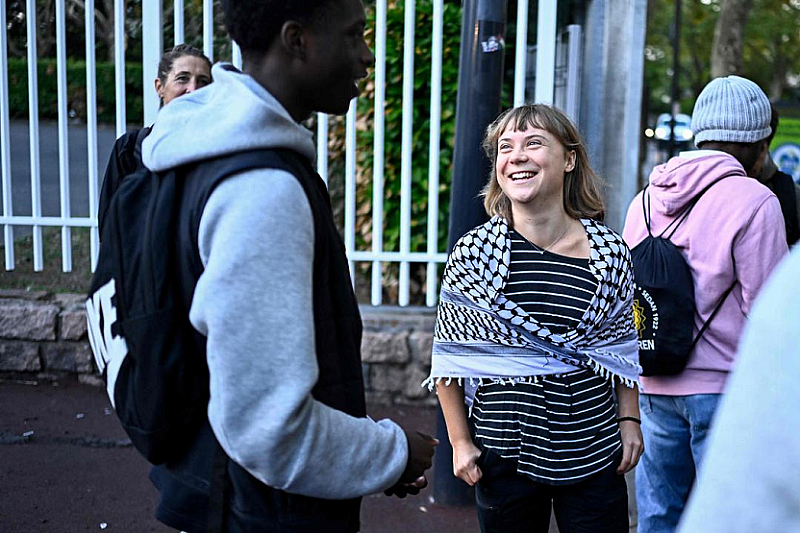
Swedish climate activist Greta Thunberg visited Lycée Paul-Éluard in Saint-Denis, in the Seine-Saint-Denis department north of Paris, to show her support for mobilised high school students. As the movement continues with new school blockades and demonstrations across France, her presence has brought renewed attention to a central question for younger generations: what kind of future awaits them?
Known worldwide for her campaign against climate change, Greta Thunberg surprised students when she appeared alongside demonstrators outside Lycée Paul-Éluard. According to Le Figaro Étudiant, around 200 people had gathered at the site. While several students did not know who the activist was before her arrival, others welcomed the support, which could help bring greater visibility to their movement.
During her remarks outside the school, Thunberg criticised the lack of investment in education and defended young people's right to mobilise for their future. She explained that she had chosen Saint-Denis partly because the movement had begun there. Le Figaro Étudiant reports on her visit and the mixed reactions among students.
Her appearance reflects the evolution of her activism, which began with climate campaigning and has increasingly included international and humanitarian issues. La Croix traces this journey, from her interventions at the United Nations to her positions on Gaza.
Thunberg's visit comes during the fifth round of a high school student movement marked by school blockades and demonstrations. Some students hope her support will help reinvigorate a campaign in which maintaining daily participation can become increasingly challenging.
Nationwide, the figures point to a substantial mobilisation, although estimates differ sharply. According to the student and high school unions' inter-union coalition, 480,000 people demonstrated across France on Tuesday, compared with 161,500 according to the Interior Ministry. These figures, reported in Le Monde's live coverage of the student movement, highlight the disagreement between organisers and the authorities over the scale of the demonstrations.
Libération's live coverage also examines this new day of demonstrations and the tensions surrounding the movement.
Although the student mobilisation is not limited to environmental demands, the presence of a leading climate activist gives it a particular resonance. Questions about investment in schools, the quality of educational infrastructure and inequalities between communities connect with a broader debate about living conditions and the opportunities available to younger generations.
The ecological transition also requires a rethink of the places where young people study: better-insulated buildings, schools adapted to extreme heat, reduced energy consumption and improved indoor comfort. These issues offer potential avenues for public policy, although they are not necessarily demands explicitly voiced by every participant in the current movement.
Greta Thunberg's activism serves as a reminder that concerns about the future can extend beyond the boundaries separating social, educational and environmental causes. Her presence, however, does not mean that all the students share the same beliefs or objectives.
In Saint-Denis, the Swedish activist's arrival attracted attention and strengthened the sense among some students that their mobilisation could be heard beyond their own school. Nevertheless, the movement's future will also depend on its demands, its ability to sustain participation and the response from public authorities.
Beyond the image of Greta Thunberg standing alongside students taking part in the blockades, the day raises an essential question: how should society respond to a generation demanding greater consideration for its future? Whether the issues concern education, social justice or the climate, the challenge remains to turn mobilisation into concrete, lasting change.
Source : News agencies

The best of Tired Earth delivered to your inbox
Sign up for more inspiring photos, stories, and special offers from Tired Earth
By signing up for this email, you are agreeing to news, offers, and information from Tired Earth. Click here to visit our Privacy Policy.


Comment