


08 Nov 2026

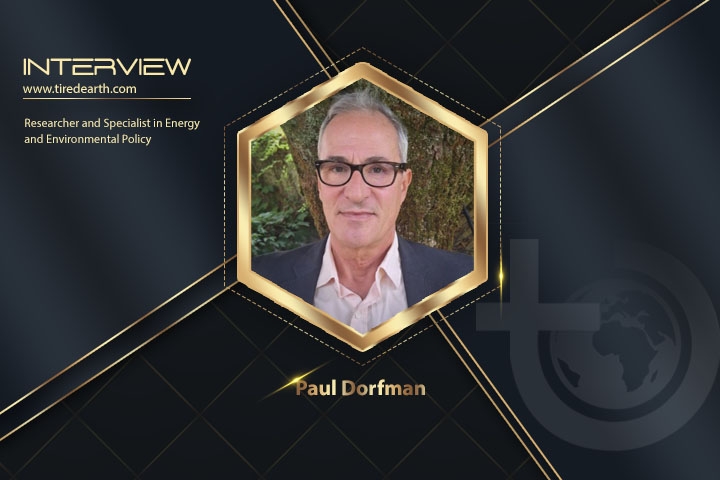
Paul Dorfman
"Nuclear power was never cheap or safe – this summer shows it’s unreliable."
1- The global energy system is changing rapidly. In your view, what will the energy mix of the future look like, and what role will renewable energy play in it?
All key international energy institutes and organisations agree that renewables will do the heavy lifting for the energy transition.
Last year, renewables supplied 85.6% of all new global power generation capacity. Solar capacity grew by 510GW and wind by 159GW, against just 1.5GW for new nuclear. That’s a 462:1 ratio. Put aside capacity, for actual annual electricity generation output, this means last year, new wind and solar supplied 104 times more usable power than new nuclear.
In the US, 2026, between 93-99% of new utility-scale electricity generating capacity will come from solar, wind, and battery storage – a combined build-out equivalent to constructing 70 new nuclear power plants in just one year, using tech that needs no uranium fuel cycle, no spent fuel storage, and no decades-long construction timeline.
Each year nuclear adds only as much net global power capacity as renewables add every two days. Globally, new nuclear average construction overruns are more than 60%. Wind and solar move from planning to generation in a few years. For renewables, the challenge isn’t generation, but how quickly grids, batteries and flexibility can be deployed.
2- You have been critical of nuclear power and have advocated for renewable alternatives. What do you believe are the strongest arguments for prioritising renewables over nuclear energy?
In the last 10 years, the global share of wind and solar power has more than quadrupled to 5,500 TWh in 2025 – whilst nuclear has stagnated. Solar alone will become the largest contributor to the world’s electricity mix from 2031. In 2025, renewables investment was $690 billion – nuclear investment was 20 times lower.
And distinguish between planned tripling of renewables by 2030 with tripling of nuclear capacity by 2050. Tripling global renewable power by 2030 (4 yrs away) means an additional 11,000 GWe. Tripling global nuclear energy capacity by 2050 (24 yrs away) means only an additional 1,400 GWe. Do the maths.
3- One of the main challenges facing wind and solar power is their intermittency. How confident are you that energy storage, smarter grids and demand management can address this challenge at a large scale?
The former head of the UK National Grid says that ‘baseload’ is an obsolete concept. Taking full account of systems costs of uninterrupted supply, for the couple of hundred hours per year of dunkelflaute (low wind and low sun) in the EU, we can sustain a reliable power system via renewables, storage, efficiency, interconnection, and stronger grids – delivering far more firm power for every pound spent.
Meanwhile, this summer demonstrates that nuclear is intermittent – with 1/5th of EDF France's nuclear capacity offline, and 13 of the 57 reactors in EDF's nuclear fleet affected. Nuclear in Hungary, Romania and Bulgaria were all impacted. Nuclear power was never cheap or safe – this summer shows it’s unreliable.
And climate impact on coastal nuclear is an order of magnitude greater. The UK Institute of Mechanical Engineers says UK reactors (together with spent nuclear fuel and rad-waste stores) is vulnerable to sea-level rise, flooding, storm surge, and ‘nuclear islanding’ – and UK coastal nuclear sites will need considerable investment to try to protect against rising sea levels, and even relocation or abandonment.
Elesewhere, the US Nuclear Regulatory Commission concludes the majority of their nuclear has already experienced flooding hazard beyond their design-base, and the US Army War College reports that nuclear facilities are at ‘high risk’ of temporary or permanent closure due to climate impact. Nuclear is, quite literally, on the climate front-line – and not in a good way.
4- Europe has faced major energy security challenges in recent years. What lessons should European countries learn from the energy crisis, particularly regarding their dependence on fossil fuels?
It’s clear that energy security is key, and dependence on fossil fuel imports significantly contributes to the problem. That said, nuclear is dependent on uranium imports, with Russian-dominated Kazakhstan providing 42% of all uranium fuel for reactors worldwide. Also, Russia provides significant unembargoed nuclear enrichment services and products for reactors across Europe, India, and the US. Russia controls 40% of global uranium enrichment capacity in 2025. So, in terms of energy security, nuclear seems profoundly insecure.
5- As the world moves towards a low-carbon economy, what do you see as the biggest environmental challenge that is currently being overlooked by policymakers and the public?
We’re in a ‘corridor of life’ – temperatures above risk a tipping point, where sustaining systems collapse. A few weeks ago, the UN Environment Program ‘Limiting Climate Overshoot’ says we must cut CO2 emissions imediately to avoid disastrous overshoot. If we do, we have a good chance of limiting temperatures to 1.7C above preindustrial levels.
The Potsdam Institute for Climate Impact Research just this year finds that the AMOC – the Atlantic Meridional Overturning Circulation – is now significantly more likely to collapse unless emmissions are brought down very, very quickly.
The frustrating thing is, we have the solutions at scale, we know how. We just need to apply. It’s a question of scale and pace. It’s not a question of if we can phase out fossil fuels – it’s about when, it’s about time.
The bad news is that new nuclear reduces and delays climate action. Very long nuclear development and build times means much longer fossil fuel burn and CO2 generation. New nuclear is too marginal, too late, too costly, for climate and energy crises. Meanwhile, the Intergovernmental Panel on Climate Change IPCC AP6 Summary reports that renewables are now ten times more efficient than nuclear at CO2 mitigation.
6- Looking ahead to 2035, are you optimistic that the world can achieve a major transition towards clean energy? What needs to happen now to make that transition successful?
I’m optimistic but realistically concerned – especially about the economic and climate impact ‘opportunity costs’ of new nuclear. This is because new nuclear reduces and delays climate action. Very long nuclear development and build times means much longer fossil fuel burn. Nuclear is just too slow, too hazardous, and too costly for the climate and energy crises.
Meanwhile, global grid-scale battery power capacity grew by 104 GW or 79% in 2025, bringing the total power capacity from less than 17 GW in 2020 to just over 263 GW in 2025. And in China, solar power generation increased by 40% in 2025, growing by 330 TWh. That’s 10 times the growth of nuclear energy in absolute terms.
It is also very important to recognise that we consistently overstate how much energy the energy transition has to replace, because we measure the wrong thing. The fact is, over two thirds of primary energy in fossil fuel and nuclear systems are lost as waste heat. This means that we have to replace much less polluting energy with clean renewables
The ‘primary energy fallacy’ is the idea that all primary energy from fossil fuels must be replaced with an equivalent amount of clean energy. Focusing on primary energy consumption targets can mistakenly make the energy transition look impossibly large or expensive, or accidentally lock in new fossil fuel and nuclear infrastructure.
The good news is that renewables-plus can and will do the heavy-lifting for the climate and energy crises.

Plastic Pollution in Cameroon and Africa Plastic Pollution in Cameroon and Africa

The best of Tired Earth delivered to your inbox
Sign up for more inspiring photos, stories, and special offers from Tired Earth
By signing up for this email, you are agreeing to news, offers, and information from Tired Earth. Click here to visit our Privacy Policy.
Comment
Reply