



04 Oct 2026

Tired Earth
By The Editorial Board
The link between the two has never been printed on a banner. Yet it crosses the Persian Gulf, the oil markets of Rotterdam, the offices of the French Treasury, and ends up washing ashore on the cold concrete of a high school in Créteil.
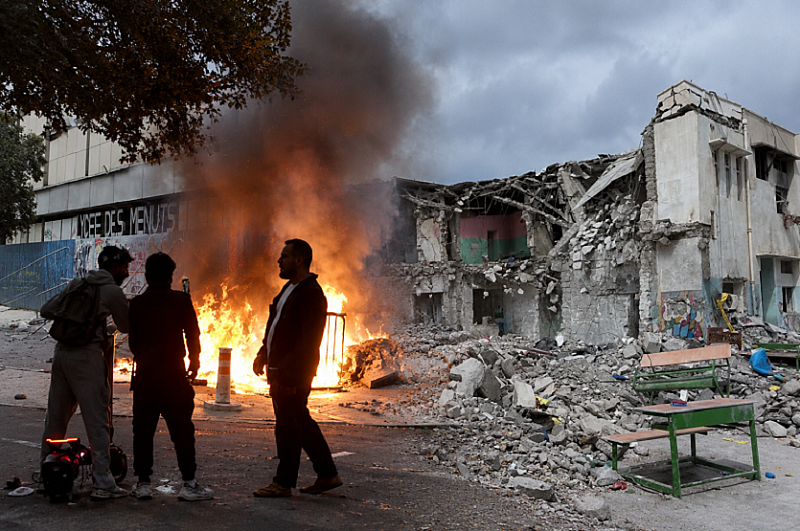
On Friday, October 2, 2026, 735 French schools were "affected" by the student movement, according to Minister of National Education Édouard Geffray. In the preceding days, approximately 2,000 people had been taken into custody, "90% of them minors." Hundreds of police officers and gendarmes were injured. One police officer was beaten unconscious in Belfort and hospitalized.
Seven months earlier, at the other end of an economic and political chain that almost no one had anticipated, a girls' primary school was bombed in Minab, in southern Iran.
The link between the two has never been printed on a banner. Yet it crosses the Persian Gulf, the oil markets of Rotterdam, the offices of the French Treasury, and ends up washing ashore on the cold concrete of a high school in Créteil.
Minab, February 28, 2026
On that day, the Shajareh Tayyebeh primary school, located in the coastal town of Minab, a few kilometers from the Strait of Hormuz, was hit by an airstrike. The death toll reported at least 159 schoolgirls killed, aged 7 to 12.
The images, authenticated by several international media outlets, show rubble, satchels, a colorful mural depicting children and pencils. Three days later, the UN High Commissioner for Human Rights called for a "swift, impartial, and thorough" investigation.
The war, meanwhile, continued.
The Price of a Barrel, the Price of Classrooms
The outbreak of the conflict involving Iran on February 28, 2026, caused a sharp rise in prices: a barrel of Brent crude went from around $70 to nearly $115, while the price of gas more than doubled, from €35 to €75 per MWh.
In France, the shockwave took a few weeks to propagate. In September 2026, INSEE recorded inflation at 3%, compared to 2.4% in August, with energy prices soaring 21.2% year-on-year. The government announced targeted subsidies: 20 centimes per liter for fishermen and haulers, 4 centimes for farmers initially, before quadrupling agricultural aid.
But targeted subsidies do not plug the budget hole. War has a cost: higher debt servicing, additional military spending, inflation eating away at room for maneuver. Prime Minister Sébastien Lecornu had to find savings. Education bore the brunt.
For the 2026 school year, 3,256 teaching positions were cut — 1,891 in primary education, 1,365 in secondary. Thanks to union mobilization, 438 positions were saved. But "90% of the planned cuts remain."
September 17, Créteil
The student movement does not begin with a great national cause. It begins with local demands, at Saint-Exupéry high school in Créteil, in support of striking teachers calling for more staff and resources. Students demand replacements for absent teachers, reinforced administrative and school health teams. Demands of a disarming banality.
Then the movement spreads. The demands broaden: study conditions, lighter schedules, school meals, inequalities between institutions. Juliette Masson, 17, a senior at Clemenceau high school in Montpellier, sums it up: "Not enough desks. We have no nurses, no monitors, and all they do for us is take away our phones." She adds: "Parcoursup, we're gambling our future on an algorithm, nothing works."
These are not revolutionary slogans. They are observations of abandonment.
The movement was born from local demands. But it grew because the ground was fertile: thousands of unreplaced teachers, dilapidated buildings, a feeling of abandonment in already fragile regions.
What the Students May Not Know
The link between Minab and Créteil is not direct. It is not mechanical. It is structural.
France did not participate in the war. It condemned it, half-heartedly. It refused overflight of its territory by planes carrying weapons to Israel. But it could not prevent the war. It could not prevent the surge in energy prices. It could not prevent the higher cost of debt, the drop in consumption, the rise in military spending, and emergency aid from translating into an untenable budget equation.
And in that equation, education is the adjustment variable.
The Lecornu government's 2026 budget initially provided for the creation of 2,000 additional positions in national education, notably to accommodate children with disabilities. These promises did not survive the war. The reality of job cuts prevailed.
It is not the first time that war has been paid for in classrooms. But rarely has the chain been so visible: from the Strait of Hormuz to a high school in Créteil, via oil markets and the spreadsheet tables of the Ministry of Economy.
A student interviewed during the blockades said this. It may not have been intended to become a slogan. But it says what matters.
French students are not blocking their schools because they read a report on the Strait of Hormuz. They are blocking them because it is cold in winter in their classrooms, because their teachers are not being replaced, because they feel their future hinges on an algorithm and no one is listening to them.
But behind this feeling of abandonment lies a broader reality. A war 5,000 kilometers away. A closed strait. A barrel of oil in flames. A budget tightening. And a decision, made somewhere in the corridors of Bercy or Matignon, to place the weight of all of it on the shoulders of those who never had a voice in the matter.
The French government did not want this war. It could not stop it. And it is the students who pay the price — in their classrooms, in their schedules, in their dreams for the future.
From Minab to Créteil, the distance is 5,000 kilometers. The journey, however, takes only a few months.
Banner image:
Right: The ruins of the Shajareh Tayyebeh primary school in Minab, Iran, after the US Tomahawk missile bombardment on February 28, 2026, causing the deaths of more than 165 students. Left: A trash fire in front of the Les Menuts high school in Bordeaux, France, during a student protest against the lack of educational resources, October 1, 2026.

The best of Tired Earth delivered to your inbox
Sign up for more inspiring photos, stories, and special offers from Tired Earth
By signing up for this email, you are agreeing to news, offers, and information from Tired Earth. Click here to visit our Privacy Policy.

Comment
Reply